New Mexico Turquoise Plate: The Centennial Design
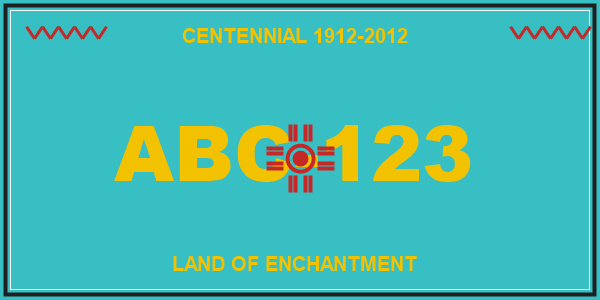
New Mexico turquoise license plate designs arrived in 2010 to mark the state’s hundredth year, and the color choice set it apart from every plate before it. Yellow characters sit on a turquoise field, and the Zia sun symbol is embossed in yellow and red at the center. The top line reads CENTENNIAL 1912-2012 and the bottom carries Land of Enchantment. This page covers what the plate looks like, the idea behind it, the reason drivers pick it, the award it won and how to order one.
New Mexico turquoise license plate requests hold the longest character limit of the three standard designs. A turquoise plate takes up to eight characters for a car or truck and six for a motorcycle, which makes it the first choice for a long phrase. The design issues with a standard registration at no added charge. A driver who wants text of their own places a prestige request on form MVD10199, and the annual charge attaches to the registration renewal.
- 2010Design released
- ABC-123Serial format
- 8Max characters on a prestige version
- 2010National best-plate award
- TurquoiseField with yellow characters
What the Turquoise Plate Looks Like
The design reverses the pairing used on the yellow plate, and the change gives it a distinct look on the road. The full range sits on the New Mexico license plates hub. Every element ties back to the state’s centenary, which gives the artwork a reason rather than a decoration. Three details decide the face of the plate.
The colors and the center
A turquoise field carries yellow characters, and the Zia sun symbol sits embossed at the center in yellow and red. The symbol comes from Zia Pueblo and carries four rays on each of four sides, a set of numbers tied to the pueblo’s own reckoning of the world. Placing it at the middle of the plate made it the largest use of the element on any New Mexico issue. The embossing gives it a raised profile that catches light at an angle, which shows up in a photograph more than on a flat print.
The words on the plate
The top line reads CENTENNIAL 1912-2012 in white, and the bottom carries LAND OF ENCHANTMENT in yellow. The the chile plate design carries the state food claim. The centennial wording ties the design to a single period, which makes an earlier turquoise plate easy to date from the top line alone. A revised version later dropped the anniversary wording and kept the turquoise field and the centered symbol, so a plate in service today may carry either version. An observer who sees the centennial line knows the plate came from the earlier run.
The serial format
The turquoise design runs on the ABC-123 pattern, three letters followed by three digits, which differs from the yellow plate at 123-ABC and the chile plate at ABCD12. The letters E, I, O, Q, U and V never appear on a regular passenger plate, so the alphabet used here is smaller than the full set. A reader who sees letters before digits knows the plate belongs to the turquoise series. A prestige version allows up to eight characters, the longest limit among the three standard designs.
The Centennial Idea
The design began as an anniversary issue rather than a permanent replacement, and the state’s own history supplied the color. New Mexico joined the union in 1912, which set the hundredth year at 2012 and left the plate to arrive two years ahead of the date.
1912 to 2012
New Mexico became a state in 1912, and the hundredth anniversary fell in 2012. The state released the plate in 2010, which gave drivers two years to fit it before the date itself arrived. The top line names the full span rather than the single year, which is why a plate issued in 2010 still reads as a centennial item. A driver who holds one of the earlier plates carries a document tied to a specific two-year window.
The 2010 release and the award
The Automobile License Plate Collectors Association named the design the best new plate of 2010, the first such award New Mexico had taken. The state issues three standard designs at the same time. The group’s yearly contest covers the United States and Canada, and the win raised the design’s profile well beyond the state. The color choice drew comment at the time, since no earlier New Mexico plate had come close to turquoise. The award set up the state’s second win seven years later with the chile plate.
The revised version
A later version of the design dropped the anniversary wording from the top line and kept the turquoise field and the centered Zia symbol. The revision left the plate in production after the centennial year passed, which is why a driver today can still choose turquoise at the counter. The original run carries the anniversary line and the revised run does not. A collector who cares about the distinction can date a turquoise plate from that single detail.
Why Drivers Choose It
The design holds two practical advantages over the other two, and a third that comes down to taste. Each one matters to a different kind of driver, and all three are easy to check before the application goes in.
Eight characters
The turquoise design takes up to eight characters on a car or truck, which is the highest limit of the three. A driver who wants specific text works through the vanity plate rules. The yellow design allows seven and the chile design six, so a longer phrase may only fit here. Motorcycle versions allow six on the turquoise design, the same as the yellow plate. A driver planning text of seven or eight characters has one clear option among the standard designs.
The readability question
Collectors noted at the time that yellow characters on a turquoise field read less sharply than red on yellow, since the two colors sit closer together in tone. The embossed characters and the reflective sheeting behind them offset most of that. The state has kept the design in production for more than a decade, which answers the question in practice. A driver who wants the highest contrast should look at the chile design instead.
The color itself
Turquoise carries a long association with the south west, and the state chose it for a reason beyond contrast. The color ties the plate to the region’s jewelry and its wide open country rather than to a national standard. A driver who wants a plate that says something about where it comes from has a clear option in the turquoise design. The choice is a statement rather than only a color preference, and the state has kept it as a standard option on that basis.
Ordering a Turquoise Plate
The design issues with a standard registration rather than through a separate program. The steps below cover a request from start to finish.
Decide between the three designs
The state issues three standard designs at the same time, and all three carry the same charge. Look at the artwork before you choose, since the turquoise field reads quite differently on a vehicle than it does on a screen. A driver who cannot decide can ask to see samples at a field office. The charge is the same whichever one you pick.
Plan your text against the eight-character limit
The turquoise design holds the most room of the three, which makes it the natural choice for a longer phrase. Count the characters rather than guessing, since a phrase that looks short on a screen can run long on a plate. Letters and numbers are the only permitted characters. A shorter phrase leaves room to spare on the plate.
Order it with the registration
The design issues in the same transaction as the registration, at no added plate charge. Tell the clerk which design you want, or select it during an online transaction. A vehicle new to the state needs its identification number checked before the plate issues. The plate arrives in the same visit rather than by post.
File the prestige application if you want your own text
A personalized version runs on form MVD10199, the application for a prestige plate on a car or a motorcycle. The form asks for your registration details and the characters you want, and the division checks the text against plates already in use. The plate then carries an annual charge collected with the renewal. Confirm the current amount on the form before you submit it.
Fit the plate and renew each year
Fit the plate on the rear, since New Mexico issues a single plate, and leave the surface clear of any cover or frame that hides a character or the sticker. Renew on time and the validation sticker keeps the plate current. A plate that has bent or faded needs replacing rather than renewing. Keep the receipt for the payment with the title.
Official plate pages
Every design with its artwork, and the standard plates page: mvd.newmexico.gov/vehicles/license-plates/ and mvd.newmexico.gov/vehicles/license-plates/standard-plates/
The Turquoise Prestige Plate
A driver who wants text of their own on the turquoise design places a prestige request rather than an ordinary registration. The artwork stays the same, and the characters replace the ordinary serial. Two details decide how a request runs.
Character limits
The turquoise design allows up to eight characters for a car or truck and six for a motorcycle, the highest limit of the three standard designs. The eight-character room covers most names, initials and short slogans without a trim. Letters and numbers are the only permitted characters, and a space, dash or symbol will not pass review. A driver with a longer idea should shorten the wording rather than looking for a design with more room.
How to apply
The application runs on form MVD10199, the online application for a personalized prestige plate for a car or a motorcycle. The form asks for your registration details and the characters you want, and the division checks the text against plates already in use. The plate then carries an annual charge collected with your registration renewal. Confirm the current amount on the application before you submit it.
Turquoise Plate Against the Other Two Designs
A driver choosing between the three standard designs weighs a short set of differences. All three carry the same charge, so the decision rests on look and on space for personal text.
Room for characters
The turquoise design allows eight characters, the yellow design seven and the chile design six. A driver with a long phrase or a full name has the most room on the turquoise plate. A driver with a short word fits any of the three. The gap matters most to a driver who wants a phrase rather than initials.
Contrast at distance
The chile design pairs black with yellow and reads the sharpest of the three. The yellow design pairs red with yellow. The turquoise design pairs yellow with turquoise, the closest of the three in tone. A driver who wants the plate read at the greatest distance looks at the chile design. One who wants the longest text looks at the turquoise.
Which plate tells the story
The yellow design reads as the classic New Mexico plate, the turquoise design ties to the state’s centennial, and the chile design carries a food-culture claim. A driver picks the story that fits rather than the one that costs least, since all three cost the same. That choice is the reason the state keeps three designs in production rather than one.
Availability and Demand
New Mexico has kept three standard designs in production for more than a decade, and the arrangement has held through two redesigns. A driver choosing turquoise today can expect the option to remain as long as the state’s plate program continues in its current form.
Whether the design will stay in production
The state has not retired a standard design since it moved to the three-design approach, and the turquoise plate has outlasted its own anniversary by more than a decade. That history suggests the option will remain as long as the current approach continues. A change would come through the legislature or through the division rather than through a quiet withdrawal. A driver who wants the design should order it as it stands rather than waiting for a reason that may never arrive.
What drives demand for a particular color
Demand follows fashion and history rather than a single factor. The chile design drew a rush in its first year for the reason a new design always does. The yellow design holds a steady following among drivers who want the classic look. The turquoise design attracts drivers who want the longest text or who like the color itself. A driver choosing between the three is choosing an identity as much as a registration document.
Frequently Asked Questions
These are the questions drivers ask most often about the New Mexico turquoise plate. Each answer stays short and points to the official source where the state publishes the current rule or fee. Where a detail affects money or a deadline, confirm it with MVD before you rely on it.
When did the turquoise plate come out?
New Mexico released the design in 2010, two years before the centennial year it marks. The top line reads CENTENNIAL 1912-2012, and the Automobile License Plate Collectors Association named it the best new plate of that year.
What does the turquoise plate look like?
Yellow characters sit on a turquoise field, with the Zia sun symbol embossed in yellow and red at the center. The top line reads CENTENNIAL 1912-2012 and the bottom carries LAND OF ENCHANTMENT in yellow.
How many characters fit on a turquoise prestige plate?
Up to eight characters for a car or truck and six for a motorcycle. The turquoise design allows the most characters of the three standard designs, with the yellow plate allowing seven and the chile plate six. Letters and numbers are the only permitted characters.
Does the turquoise plate cost more than the others?
No. All three standard designs issue with a standard registration at no added plate charge. A personalized version carries an annual amount collected with the renewal, and the same figure applies whichever of the three designs you choose.
Is the turquoise plate still issued?
Yes. The turquoise design, the yellow design and the chile design all stay in production at the same time, and none has replaced the others. A revised version dropped the anniversary wording and kept the turquoise field and the centered symbol.