New Mexico License Plate Gallery and Design Reference
New Mexico license plate pictures help a driver pick a design and help a reader place a plate they have seen on the road. The state issues three standard designs at once, each with its own colors, artwork and serial pattern. This page describes every design in enough detail to recognise it, and it explains where each element sits on the face of the plate. A reader looking for the yellow, turquoise or chile design will find a written reference here.
New Mexico license plate images cover the wider catalogue, since specialty designs carry their own artwork rather than a standard background. A collegiate plate carries a campus mark, a wildlife plate carries a species and a veteran plate carries a service line above the serial. Each design keeps the same size and the same materials, so the difference between them sits in the print rather than in the metal.
- 3Standard designs
- 12 x 6 inPlate size
- AluminumBase material
- EmbossedCharacter style
- ReflectiveSheeting behind the characters
The Three Standard Designs
Each standard design uses the same physical plate and a different print, which makes the face the only thing that changes. The full range sits on the New Mexico license plates hub. The descriptions below cover what sits where, so a reader can match a plate against them without a photograph in hand.
Yellow, with red characters
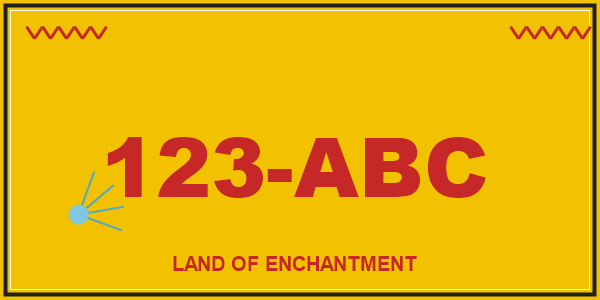
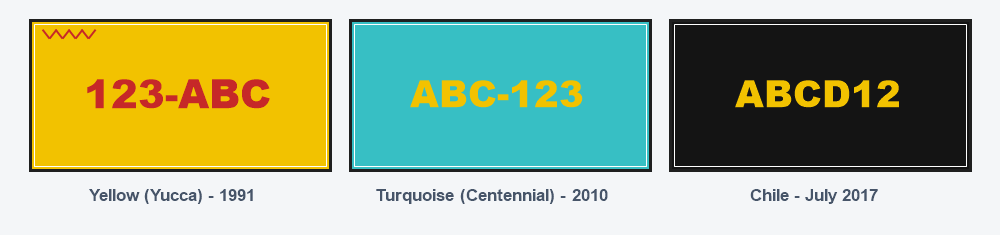
The yellow design carries red characters on a yellow field, with a light blue yucca at the lower left and Native zigzag bands at the top corners. The state introduced it in 1991, and the serial runs as 123-ABC with the letters E, I, O, Q, U and V left out. A stamped recess at the top center once held a county-name sticker, a feature the state later dropped. The bottom carries the words Land of Enchantment.
Turquoise, with yellow characters
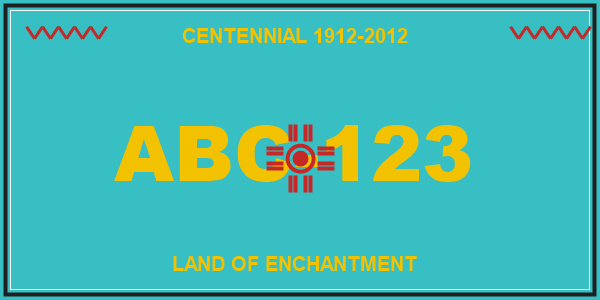
The turquoise design carries yellow characters on a turquoise field, with the Zia sun symbol embossed in yellow and red at the center. The state issues three standard designs at the same time. The top line reads CENTENNIAL 1912-2012 and the bottom carries LAND OF ENCHANTMENT. The serial runs as ABC-123. New Mexico released the design in 2010, and a revised version later dropped the anniversary wording and kept the field and the centered symbol.
Black, with yellow characters and chile peppers
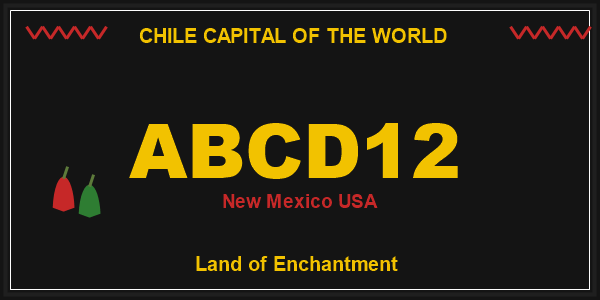
The chile design carries yellow characters on a black field, with a red chile and a green chile screened at the left. The top line reads CHILE CAPITAL OF THE WORLD and the bottom carries Land of Enchantment in green. The words New Mexico USA sit in red below the serial, which runs as ABCD12. New Mexico released the design on 10 July 2017, and it took a national best-plate award that year.
| Design | Field and characters | Artwork position | Serial |
|---|---|---|---|
| Yellow (Yucca) | Red on yellow | Yucca lower left, bands top corners | 123-ABC |
| Turquoise (Centennial) | Yellow on turquoise | Zia sun symbol centerd | ABC-123 |
| Chile | Yellow on black | Red and green chile at the left | ABCD12 |
Specialty and Cause Designs
A specialty design replaces the standard background with artwork tied to a cause, a group or an institution. A collegiate plate carries the campus mark, a wildlife plate carries a species and a veteran plate carries a service line across the top. A route 66 design carries the historic highway mark, and an organ donor design carries a Donate Life mark at the left. Each one keeps the same materials and the same size, so the difference sits in the print rather than in the metal.
Historic Designs
Older New Mexico plates turn up on the road, at swap meets and in garages, and a few of them explain details on the modern designs. The 1932 issue carried the words SUNSHINE STATE rather than the line drivers know today. The 1940 plate marked the four hundredth anniversary of the Coronado expedition, and a county code sat at the front of the serial between 1947 and the 1970s. A collector uses the color, the slogan and the serial to date a plate that carries no year on its face.
How to Use These Images
A plate photograph serves three audiences, and each one uses it differently. The the chile plate design carries the state food claim. A driver choosing a design wants to see the colors at full size, since a turquoise field reads quite differently on a vehicle than it does on a screen. A collector dating a plate wants the serial and the slogan in the same frame, since those two details settle the year. A researcher or a journalist wants a clean image with the artwork visible and no cover or frame across the face. A photograph that shows the whole plate against a plain background works for all three.
Materials and Size
Every New Mexico design uses the same physical plate, which keeps the look consistent across the catalogue. The state starts with aluminum sheet and finishes at the 12 by 6 inch size used across North America. The characters are embossed rather than printed flat, which gives the face a raised profile, and reflective sheeting behind them keeps the plate readable at night. Waldale Manufacturing Limited of Amherst, Nova Scotia produces the plates. A screen print adds the artwork and the slogan on top of the embossed characters, which is why the colors sit slightly above the metal on a close look.
How to Photograph a Plate
A clean photograph of a plate serves a driver, a collector and a researcher, and the method is the same for each. Three details decide whether the image works.
Light and angle
Shoot the plate in daylight rather than under a lamp, since a reflective surface throws back whatever light reaches it. The the turquoise plate design allows the longest text. Stand square to the plate rather than at an angle, so the characters stay the same size across the face. A slightly overcast day works better than bright sun, since the sheeting scatters direct light. Avoid a flash, which leaves a white patch over part of the print.
Background and framing
Fill the frame with the plate rather than the vehicle, so the artwork and the serial both read at full size. A plain background helps a collector compare two plates side by side. Leave a small margin around the edges rather than cropping into the border. Include the whole face, since a partial image cannot confirm the design.
What to include for a collector
A collector wants the serial and the slogan in the same frame, since those two details settle the year. A photograph of the back helps as well, since repairs and re-backing show there. Note the plate’s own details alongside the image rather than relying on the picture alone. A written note with the year and the design makes the image useful later.
What Each Element Looks Like
A reader comparing a plate against a description needs to know where each element sits. Three details appear on every New Mexico design in a fixed position.
The serial
The serial sits across the middle of the plate, and each design arranges its characters in a way of its own. The yellow design runs on 123-ABC, the turquoise design on ABC-123 and the chile design on ABCD12. A reader who sees letters before digits knows the plate belongs to the turquoise series. Four letters points to the chile design.
The slogan and the state name
The state name and the slogan sit at the edges of the face rather than in the middle. The yellow design carries Land of Enchantment along the bottom. The turquoise design adds the centennial line across the top. The chile design carries a headline at the top, the state name below the serial and the slogan at the bottom. Reading the edges confirms the design before the serial does.
The artwork
The artwork occupies a corner or the center rather than the whole face. The yucca sits at the lower left of the yellow plate, with zigzag bands at the top corners. The Zia sun symbol sits at the center of the turquoise plate. Two chile peppers sit at the left of the black design. A reader who checks the artwork position confirms the design at a glance.
Where to Find Reference Images
A reliable reference beats a random search result, and three sources cover almost every question.
The state’s own pages
The division’s plate pages carry artwork for every design, and the standard plates page shows the three in production. Use those images as the reference rather than a photograph from an unrelated site, since a listing may show a retired design. The state’s pages name the current status of each option as well. A reader who wants the current position should start there.
Collector references
The Automobile License Plate Collectors Association publishes material on how to date an issue, and its members hold runs that a public page does not cover. A collector reference helps with an older plate that the state no longer produces. Use it for the year range rather than for a current fee. A dated reference is worth keeping alongside the plate itself.
What to avoid
A marketplace listing often shows a plate that has been restored, which hides the condition a buyer needs to judge. A stock image site may carry a plate from another state under a generic caption. A social media post rarely names the year or the design. Use those sources for a rough look rather than for a reference a decision rests on.
Frequently Asked Questions
These are the questions readers ask most often about New Mexico plate designs. Each answer stays short and points to the official source where the state publishes the current catalogue. Where a detail matters to a collector or a purchase, confirm it against a reference rather than a memory.
How many New Mexico license plate designs are there?
Three standard designs sit alongside a catalogue of specialty options. The standard group covers the yellow, turquoise and chile plates, and everything beyond those three carries a fee of its own. The state lists the full catalogue on its own page.
What does each standard design look like?
The yellow design carries red characters with a yucca at the lower left. The turquoise design carries yellow characters with the Zia sun symbol centerd. The chile design carries yellow characters on black with red and green chile peppers at the left.
What size is a New Mexico license plate?
New Mexico plates match the 12 by 6 inch size used across North America. The state produces them from aluminum sheet with embossed characters and reflective sheeting behind them. Waldale Manufacturing Limited of Amherst, Nova Scotia makes them.
Where can I find official plate images?
The state’s own plate pages carry artwork for every design, and the standard plates page shows the three in production. Use those images as the reference rather than a photograph from an unrelated site, since a listing may show a retired design.
Why do some plates carry different wording at the top?
The top line names the design rather than the driver. The turquoise plate reads CENTENNIAL 1912-2012, the chile plate reads CHILE CAPITAL OF THE WORLD, and a veteran plate may carry a service line. The yellow plate carries the slogan alone at the bottom.