
New Mexico Disability and Handicap Plates
New Mexico handicap license plates fall under the state’s limited mobility program, and the rules behind them are set out in statute rather than in a policy note. A driver qualifies on a medical basis, and a healthcare provider certifies the condition before the state issues anything. The design sits apart from the standard three, and it carries no fee of its own. This page covers who qualifies, what the certification asks for, the difference between a plate and a placard and the steps to apply.
New Mexico handicap license plate requests run through a form of their own rather than through an ordinary registration. The state publishes an application for the mobility limitation plate, and it names the medical conditions that qualify. A driver who does not qualify for the plate may still qualify for a placard that hangs from the mirror, which covers a different set of situations. Each route has its own conditions and its own paperwork.
- 6Qualifying conditions in statute
- MVD10270Mobility limitation application
- ProviderWho certifies the condition
- HPPlate code the state uses
- No feeCharge for the design itself
Limited Mobility Plates in New Mexico
The program covers drivers who meet a medical test rather than a general one, and the statute names the conditions in full. The full range sits on the New Mexico license plates hub. The plate carries the mobility marker rather than an ordinary serial alone, which lets an officer or a parking officer recognise it without a check.
What the plate shows
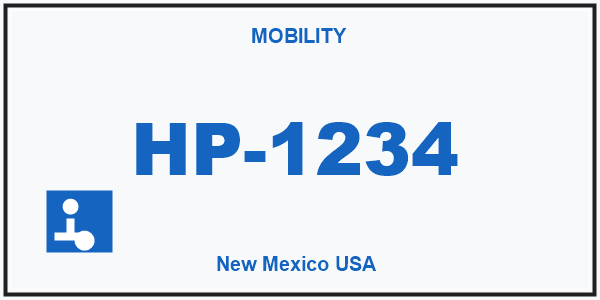
A limited mobility plate carries the marking the state uses for the program, along with a registration record tied to the vehicle. The display rule sits in the license plate laws. The design gives a holder the parking privilege the program provides, and it removes the need to display a separate placard in the window. The plate renews with the registration on the ordinary yearly cycle, and the mobility status carries forward as long as the certification stands. A driver who no longer meets the medical test should let the plate lapse rather than renew it.
Plates and placards
A plate stays with the vehicle, and a placard moves with the person. The display rule sits in the license plate laws. A driver who uses different cars finds a placard more practical, since one document covers every vehicle they drive. A driver who keeps a single car may prefer the plate, since it needs no window display and cannot be left behind. The state publishes separate routes for each, and the medical test behind them is the same.
What Qualifies for the Program
The statute lists six conditions, and a driver meets the test by matching any one of them. A healthcare provider certifies the condition rather than the driver assessing it alone.
The six conditions in statute
A person qualifies who cannot walk 100 feet without stopping to rest. The list covers a person who cannot walk without a brace, a cane, a crutch, another person, a prosthetic device, a wheelchair or another assistive device. It covers a person restricted by lung disease to a measured degree, a person who uses portable oxygen and a person with a severe cardiac condition. It covers a person so limited by an arthritic, neurologic or orthopedic condition that ten stair steps cannot be managed.
Who certifies the condition
A healthcare provider signs the certification rather than the driver, and the state publishes the application for the mobility limitation plate as form MVD10270. Most tasks finish at one of the MVD office locations. The provider records the condition against the criteria the statute sets, which is why the form asks for a clinical detail rather than a general statement. A driver should take the form to an appointment rather than filling it in alone, since the medical section belongs to the provider.
How to Apply for a Mobility Plate
The application needs a medical signature before it reaches the state, and the steps below cover the route from start to finish.
Confirm that a condition on the list applies
Read the six conditions before you start, since the program covers a defined set rather than a general difficulty with walking. Most tasks finish at one of the MVD office locations. A driver who does not match a listed condition may still qualify for a placard under a different route. Bring the list to an appointment rather than deciding on your own. A provider settles the question rather than the driver.
Take form MVD10270 to a healthcare provider
The state publishes the mobility limitation application as form MVD10270. A worn surface calls for a license plate replacement. A provider records the condition against the criteria the statute sets, so the medical section belongs in a clinical setting. Book the appointment with enough time before your registration renewal, since the form has to travel with the rest of the paperwork. The form carries a clinical section the provider fills in.
Complete the driver section
Fill in the vehicle details, the registration information and your own identification details, then sign the form. A worn surface calls for a license plate replacement. A missing detail sends the request back rather than moving it forward, so read the instructions once before you sign. Keep a copy of the completed form, since a replacement plate later may need the same evidence. A legible signature avoids a delay at the counter.
Submit it with your registration
Hand the application in with the registration at a field office, or follow the route the state lists for the program. The design carries no fee of its own, so the ordinary registration charge is the only amount that applies. Ask for a receipt that names the design, since a question about the plate later is easier to answer with one.
Fit the plate and renew on the ordinary cycle
Fit the plate on the rear, since New Mexico issues a single plate, and keep the surface clear of any cover that hides a character or the sticker. Renew on time and the mobility status carries forward as long as the certification stands. A driver whose condition changes should not renew the plate on the old certification.
Official form and statute
The mobility limitation application and the special plates chapter: mvd.newmexico.gov/forms/most-popular-forms/ and mvd.newmexico.gov/chapter-7-special-plates/
Renewal and Replacement
A mobility plate renews with the registration on the ordinary yearly cycle, and the design carries no fee of its own. A plate that has bent, cracked or faded needs replacing, and the replacement follows the same route as any other design. The medical certification behind the plate stands until the condition changes or the provider’s certification period ends, so a driver should check the paperwork before each renewal rather than assuming it carries forward. A driver who no longer meets the test should stop renewing the plate rather than keep the marking on the road.
Living With a Mobility Plate
A limited mobility plate changes a few everyday details, and a driver who knows them uses the program with less friction. Three points come up most often.
Where the plate works
The plate carries the mobility marking, which gives a holder the parking privilege the program provides. It removes the need to display a separate placard in the window. The marking belongs to the plate rather than to the driver, so a second person who drives the same vehicle uses the same plate. That arrangement suits a household with one vehicle and two drivers.
Where a placard works better
A placard moves with the person rather than with the vehicle, so a driver who uses different cars finds one document covers every vehicle they drive. A driver who keeps a single car may prefer the plate, since it needs no window display and cannot be left behind. The state publishes separate routes for each, and the medical test behind them is the same. Pick the route that matches how you actually travel.
Parking rules and enforcement
The marking gives entry to spaces reserved for the program, and a driver should treat those spaces as reserved rather than convenient. A vehicle without the marking that uses a reserved space draws a fine. A plate that has bent or faded needs replacing rather than renewing, since the marking must stay legible. Report a lost or stolen plate the same way as any other design.
Plates, Placards and Renewal
The two routes share a medical test and differ in how the document travels. Renewal follows the registration either way.
Renewing a mobility plate
The plate renews with the registration on the ordinary yearly cycle, and the design carries no fee of its own. The mobility status carries forward as long as the certification stands, so check the paperwork before each renewal. A driver who no longer meets the medical test should let the plate lapse rather than renewing it on an old certification. A replacement for a damaged plate carries its own charge.
Renewing a placard
A placard carries its own expiry, which may fall on a different date from the registration. A driver who holds both should track the two dates rather than assuming they run together. The medical certification sits behind the placard, so a renewal needs the same evidence as the first application. Confirm the current position with the division rather than working from an older notice.
What happens when the condition changes
A driver whose condition improves should stop renewing the plate or the placard rather than keeping the marking on the road. A driver whose condition worsens may qualify for a design they did not meet before. The medical test sits in the statute, so a change in circumstance can change the answer. Take the form to an appointment rather than filling it in alone.
How the Certification Works
The program runs on a medical certification rather than on a driver’s own assessment, which is why a provider signs the form. Three details govern the paperwork.
Who signs the form
A healthcare provider records the condition against the criteria the statute sets, so the medical section belongs in a clinical setting. The state publishes the application for the mobility limitation plate, and the driver completes the vehicle and registration sections. The provider’s signature carries the weight rather than the driver’s description. Book the appointment with enough time before the renewal date.
What the certification records
The form asks for a clinical detail rather than a general statement, since the statute lists six specific conditions. The first covers a person who cannot walk 100 feet without resting, and the rest cover mobility aids, lung disease, portable oxygen, a severe cardiac condition and a limit on stair steps. The provider matches the condition to the list rather than to a general difficulty with walking. A driver who does not match a listed condition may still qualify for a placard under a different route.
How long a certification lasts
A certification stands until the condition changes or the provider’s period ends, which means a driver should check the paperwork before each renewal rather than assuming it carries forward. A permanent condition may need a fresh form at intervals set by the provider. A temporary condition may need a shorter period. Confirm the position with the provider rather than with a neighbour who holds a plate.
Frequently Asked Questions
These are the questions drivers ask most often about New Mexico mobility plates. Each answer stays short and points to the official source where the state publishes the current rule. Where a detail affects money or a medical step, confirm it with MVD or with a provider before you rely on it.
Who qualifies for a handicap plate in New Mexico?
The statute names six conditions, and a driver meets the test by matching any one. The list covers a person who cannot walk 100 feet without resting, a person who needs a brace, cane, crutch, wheelchair or portable oxygen, a person with a severe cardiac condition and a lung disease measurement.
What form do I use for a mobility plate?
The state publishes the mobility limitation application as form MVD10270. A healthcare provider records the condition against the criteria the statute sets, and the driver completes the vehicle and registration sections. Take the form to an appointment rather than filling it in alone.
What is the difference between a plate and a placard?
A plate stays with the vehicle, and a placard moves with the person. A driver who uses different cars finds a placard more practical, since one document covers every vehicle. A driver who keeps a single car may prefer the plate, which needs no window display.
Does a mobility plate cost anything?
The design carries no fee of its own, so the ordinary registration charge by weight and county is the only amount that applies. That places it alongside the standard three designs rather than the specialty catalogue. A replacement for a damaged plate carries its own charge.
Can I keep the plate if my condition improves?
A driver who no longer meets the medical test should stop renewing the plate rather than keep the marking on the road. The certification stands until the condition changes or the provider’s period ends, so check the paperwork before each renewal rather than assuming it carries forward.