New Mexico License Plates: Types, Designs and Fees
New Mexico license plate designs give drivers three standard looks, each one tied to the state’s own culture. You can register a car with the red-on-yellow yucca plate, the turquoise Centennial plate built around the Zia sun symbol, or the black Chile plate that reads Chile Capital of the World. Every option carries the same legal weight, so the choice comes down to style and a small set of fees. This page explains what each plate looks like, what it costs, and how to order one.
New Mexico license plates stay with the owner, not the car, which changes how a sale works. When you sell, trade or gift a vehicle, you keep the plate and have 30 days to let MVD destroy it or move it to a vehicle of the same class. Renewal happens through a validation sticker. Plates are made by Waldale Manufacturing in Amherst, Nova Scotia, and only a rear plate is required. This page covers all designs, the fee schedule, the rules that apply, and the steps to order your plate.
- 3Standard designs
- 8Max vanity characters
- Rear onlySince 1961
- 1912First NM plates issued
- Land of EnchantmentPlate slogan since 1941
New Mexico License Plate Designs: The Three Standard Choices
New Mexico issues three standard designs. Each one comes with a standard registration at no added plate charge, and each one carries a serial pattern of its own. The table further down sets the three side by side.
Yellow (Yucca) plate
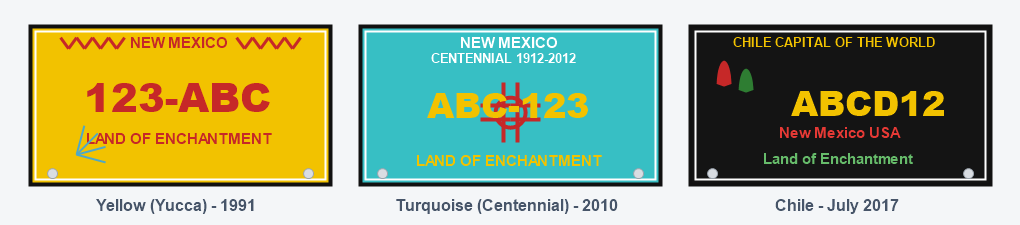
This is the plate most drivers picture when they think of the state. Red characters sit on a yellow field, the state flower runs along the lower left in light blue, and Native zigzag bands mark the top corners. New Mexico introduced this design in 1991. A county-name sticker was once pressed into a stamped recess at the top center; that practice ended years ago. The serial reads 123-ABC.
Turquoise (Centennial) plate
A yellow serial sits on a turquoise field, with the Zia sun symbol embossed in yellow and red at the center. The cycle repeats at each license plate renewal. New Mexico released this design in 2010 to mark its centennial, so the top line reads CENTENNIAL 1912-2012 and the bottom reads LAND OF ENCHANTMENT. The serial reads ABC-123. The Automobile License Plate Collectors Association named it the best new plate of 2010.
Chile plate
Black forms the field, yellow characters form the serial, and a red chile and a green chile are screened at the left. The top line reads CHILE CAPITAL OF THE WORLD and the bottom carries Land of Enchantment. New Mexico released the design in July 2017, moving early in a long-standing contest with Colorado over that claim. The serial reads ABCD12. The same association named it the best new plate of 2017.
| Design | Introduced | Field and characters | Serial format | Slogan |
|---|---|---|---|---|
| Yellow (Yucca) | 1991 | Red on yellow, yucca at lower left | 123-ABC | Land of Enchantment |
| Turquoise (Centennial) | 2010 | Yellow on turquoise, Zia sun symbol centerd | ABC-123 | Centennial 1912-2012 |
| Chile | July 2017 | Yellow on black, red and green chile at left | ABCD12 | Chile Capital of the World |
Those two contest wins are the only ones New Mexico has taken in the association’s yearly award. The yellow plate holds a following for a different reason: it reads as the classic New Mexico plate, and it has stayed in production for more than three decades.
Government, agency, elected official and commercial plates follow separate rules and are not open to public order. Plates tied to a single vehicle class, such as manufactured homes, recreational vehicles and trailers, run on their own schedule. The three designs above cover passenger cars, trucks and, in shorter sizes, motorcycles.
Where to confirm the current designs
The Motor Vehicle Division lists every design and its artwork on the official site, and the page is worth a look before you order, since the photographs there show each plate at full size. A driver who wants specific text works through the vanity plate rules. Standard designs sit on one page, and the wider catalogue covers every specialty option with its statute and fee. If a design has been retired, the same pages note that too. Confirm what MVD issues today at mvd.newmexico.gov/vehicles/license-plates/ and mvd.newmexico.gov/vehicles/license-plates/standard-plates/
How to Get a New Mexico License Plate: Seven Steps
A New Mexico license plate arrives with your vehicle registration. There is no separate plate counter, no online plate shop, and no way to buy a plate on its own. You register the vehicle, pick one of the three standard designs, and MVD issues the plate in that same transaction. The steps below cover a first-time registration; renewals follow a shorter path.
Check that New Mexico registration applies
New Mexico requires registration for passenger cars, trucks, motorcycles, recreational vehicles, motor homes, buses, manufactured and mobile homes, trailers, and off-highway vehicles such as ATVs and snowmobiles. If you live in the state and keep a vehicle here, registration is your route. New residents have a short window after establishing residency, so clear this early. Registration follows the vehicle class, so confirm which class applies to your vehicle before you collect documents.
Gather the paperwork
Expect to show proof of ownership, proof of insurance and identification. The fee structure differs on specialty and cause plates. A certificate of title or a completed title application covers ownership for a vehicle you already hold. A bill of sale covers a private purchase. MVD can ask for a VIN inspection when a vehicle arrives from another state. Keep a copy of everything you hand over, and photograph the originals before you leave the house.
Complete the registration
Registration happens at an MVD field office, and most locations ask you to book an appointment before you arrive. Online services handle many renewals and a set of other transactions, and mail works in select cases. Third-party providers handle registration for a service charge; those are private businesses and hold no government authority. Check the current options before you travel to an office, and allow an hour at the counter.
Pick your design
The three standard designs cost nothing beyond the standard registration, so the choice rests on taste rather than price. Tell the clerk which one you want, or select it during an online transaction. Ask to see samples if you cannot decide, since the turquoise and chile designs read quite differently on a vehicle than they do on a screen. Plates that carry text of your own choice follow a separate application, covered in the prestige section below.
Pay the fees
Registration fees follow the vehicle’s weight and the county where it is registered, so two neighbours with different cars pay different amounts. Specialty designs add a charge of their own, and a prestige plate adds an annual amount on top. Ask for a receipt and keep it with your title, since a lender or a future buyer may ask for proof. The cost section below lists the plate-related charges MVD publishes.
Attach the plate
New Mexico has required only a rear plate since 1961, so a front plate is never issued and never needed. Mount it where it stays visible and readable, at a height that keeps it clear of the bumper and the tow hook. Leave the surface uncovered; a tinted shield or a frame that hides any part of the plate can draw a citation. Check that the plate lamp lights the characters after dark.
Keep the plate valid
Your registration carries a validation sticker showing the expiry month and year, and that sticker must stay on the plate and readable. Renew before that date and the plate stays live. Let it lapse and you face late charges, plus the risk of driving on an expired registration. Set a reminder for the month before, since a renewal notice can go astray after a move.
Text of your own choice? File form MVD10199, the online application for a personalized prestige plate. That form runs alongside your registration rather than replacing it.
Official registration pages
The state publishes the full registration process, the current fee schedule and every form you may need. The forms page carries the title application, the bill of sale and the prestige plate application in one list, most of them ready to fill in on screen. Read the requirements page before you gather documents, so a missing item does not cost you a second trip. Fees, forms and current options live here: mvd.newmexico.gov/vehicles/vehicle-registration/ and mvd.newmexico.gov/forms/most-popular-forms/
What a New Mexico License Plate Costs
Two separate charges apply. The first is the registration fee, which follows vehicle weight and county. The second is any charge attached to the plate itself. A standard design adds nothing beyond the registration. Specialty and prestige designs carry their own amounts, and the list below covers the figures MVD publishes.
| Item | Cost | Notes |
|---|---|---|
| Standard plate (yellow, turquoise or chile) | No added plate charge | Registration fee applies separately |
| Chile plate replacement | $17 in person / $7.25 online | For a lost or damaged chile plate |
| Sample “WELCOME” and “Fun” plates | $9.99 each | Marked NOT FOR REGISTRATION |
| Smokey Bear plate | $50 initial / $40 renewal | Supports forest fire prevention |
| Amateur radio operator plate | $5 initial and each renewal | Requires an FCC license |
| Share with Wildlife plate | $27 initial / $12 renewal | No vanity version issued |
| Bass Fishing plate | $27 initial / $10 renewal | Supports bass habitat work |
| Pollinator Protection plate | $27 initial / $15 renewal | Supports pollinator programs |
| Autism Awareness plate | $35 initial and each renewal | Not available for motorcycles |
| Pet Care (Spay-Neuter) plate | $37 initial and each renewal | Supports spay and neuter work |
| Breast Cancer Awareness plate | $37 initial and each renewal | Funds screening and outreach |
| Route 66 plate | $37 initial and each renewal | Funds Route 66 preservation |
| Cumbres and Toltec Railway plate | $40 initial and each renewal | Supports the scenic railroad |
| FFA plate | $35 initial / $25 renewal | Funds student agriculture programs |
| Acequia and Community Ditch plate | $30 initial and each renewal | Not available for motorcycles |
Specialty plate charges sit on top of the standard registration, never in place of it. Where a plate supports a cause, the statute splits the amount between the department and the receiving fund. Amounts change when the legislature adjusts them, so confirm the current figure before you pay.
Registration fees move with vehicle weight and county. Confirm the amount for your vehicle on the official fee schedule rather than relying on a figure printed elsewhere.
Renewal and Plate Ownership
New Mexico is a plate-to-owner state. The plate belongs to the person, not to the vehicle, and that single rule shapes almost every private sale in the state.
Annual renewal
Registration runs on a yearly cycle. MVD mails a renewal notice before the expiry month, and the validation sticker that arrives with your payment keeps the plate current. Renewal is available online, in person, by mail and through self-service kiosks. Late renewal carries additional charges, and driving on an expired registration brings its own penalty. Set a reminder for the month before, since a notice can go astray after a move.
Selling, trading or gifting a vehicle
Take the plate off before the vehicle leaves your hands. You then have 30 days to either have MVD destroy it or have it assigned to another vehicle of the same class. The buyer registers the vehicle and receives a plate of their own. Leaving your plate on a vehicle you no longer own creates a record you do not want.
Moving a plate to a new vehicle
Plates move between vehicles in the same class, so a passenger plate follows you to another passenger vehicle. The record stays under your name, and MVD updates the plate against the new vehicle. Crossing into a different class, such as moving from a car to a motorcycle or to a trailer, calls for a new plate instead. Handle the change within 30 days of the swap to keep the registration valid.
Lost, damaged or stolen plates
A defaced or unreadable plate must be replaced. Order a replacement through MVD, pay the replacement charge, and fit the new plate once it arrives. A stolen plate merits a report to law enforcement plus a replacement order, so the record shows the plate is no longer yours to answer for. Until the new plate arrives, keep the paperwork with you in case a stop raises a question.
Vanity and Prestige Plates in New Mexico
New Mexico calls a plate with your own text a prestige plate. The terms vanity plate, personalized plate and custom plate all point to the same item, and the state uses “prestige” on its forms and in its statutes.
Character limits by design
The design you choose sets how many characters you can use, so a longer phrase may rule out the chile plate. A turquoise plate takes up to eight characters, a yellow plate up to seven, and a chile plate up to six. Motorcycle versions allow fewer on each design. Letters and numbers are the only characters permitted, and every one you type counts toward the limit.
| Design | Car or truck | Motorcycle |
|---|---|---|
| Yellow | 1 to 7 characters | 1 to 6 characters |
| Turquoise | 1 to 8 characters | 1 to 6 characters |
| Chile | 1 to 6 characters | 1 to 5 characters |
What is not allowed
Special characters are out, so a space, dash, underscore, asterisk, hash mark or a Zia symbol will not pass. MVD rejects a request in three cases: the text duplicates a plate already in use, the division finds it derogatory or obscene, or the text states or suggests that the vehicle or driver represents government authority. A rejection leaves the plate unused until you submit a different set of characters, so keep a second choice ready.
How to apply
File form MVD10199, the online application for a personalized prestige plate for a car or a motorcycle. The form asks for your registration details and the characters you want, and the division checks the text against plates already in use before it issues the plate. The plate then carries an annual charge collected with your registration renewal. Confirm the current amount on the application before you submit it.
Novelty and sample plates
New Mexico sells sample and “Fun” plates for $9.99 each, and every one carries the words NOT FOR REGISTRATION so it cannot sit on a registered vehicle. Buyers use them as gifts, wall pieces and desk displays rather than as equipment for a car. Collectors chase historic and second-hand plates through private sellers and swap meets instead, where value follows age, condition and rarity. Confirm the current price before you order.
Specialty and Cause Plates
Beyond the three standard designs, New Mexico issues a broad catalogue of plates tied to a cause, a group or a branch of service. Each one carries its own fee, and many direct part of that fee to a specific fund. Categories include:
- Collegiate — plates for the University of New Mexico, New Mexico State University, Eastern New Mexico University, New Mexico Highlands University, the New Mexico Military Institute and the School of Mines
- Military and veterans — armed forces veteran plates, disabled veteran plates, Purple Heart, Medal of Honor, Prisoner of War, Gold Star Family and active National Guard
- Wildlife and conservation — Share with Wildlife, pollinator protection, deer, elk, quail, Gila monster and bass fishing
- Health and community — organ donor, autism awareness, breast cancer awareness, pet care, blood donor and children’s trust fund
- Heritage and service — Route 66, Cumbres and Toltec Railway, farm and ranch, acequia, 4-H, FFA, amateur radio and the Smokey Bear fire prevention plate
- Mobility – limited mobility plates, plus wheelchair and disability designs
- Historic use — year-of-manufacture plates for vehicles 30 years and older, and horseless carriage plates
Some designs carry no fee at all. Medal of Honor, Purple Heart, Prisoner of War and National Guard plates fall into that group, and the statute waives the registration charge for several of them. Others run from a few dollars to fifty dollars a year. Confirm the amount for the design you want before you apply.
Full specialty catalogue
The chapter runs through every plate the state offers, grouping them by purpose and quoting the statute that created each one. Fees sit beside the designs, along with the amount that reaches the receiving fund. Eligibility rules differ from plate to plate, so read it once before you apply. Applications follow the same route as a standard registration, with a form for each category. Every design, its statute and its fee: mvd.newmexico.gov/chapter-7-special-plates/
New Mexico License Plate Rules
New Mexico keeps the rules on plate display short, and most drivers meet them without thinking about it. The state issues a single rear plate, requires that plate to stay readable, and asks that the plate lamp work after dark. The points below cover what a plate must look like, where it goes, and which add-ons can turn a routine stop into a citation.
One plate, on the rear
New Mexico has required a single rear plate since 1961. You will not receive a front plate, and there is no front-plate requirement to meet, which sets the state apart from neighbours that issue two. A second plate from another jurisdiction serves no purpose here, and a decorative front plate is not a substitute for registration. Keep the rear plate legible, upright and firmly bolted.
Covers, shields and frames
A plate must stay readable at all times. Tinted covers, smoked shields and frames that cross the characters or hide the state name can draw a citation, and a plate that a camera or an officer cannot read counts as an offense. The same rule catches a plate bent so that a character folds away. A plain frame that leaves every character, the state name and the sticker visible is the safe choice.
Plate lamp
The rear plate needs a white lamp that makes the characters legible after dark, and the lamp must not show a color other than white. A burnt-out bulb is a simple fix and a common reason for a traffic stop, since an officer can spot an unlit plate before anything else on the vehicle. Check the bulb whenever you check your tyres, and replace it the same day it fails.
Mounting and condition
Fit the plate where it sits upright and secure, at a height that keeps it visible and clear of the road surface. Replace a plate that has bent, cracked or lost its reflective surface, since a damaged plate cannot be renewed in place. A missing bolt or a plate held on with tape invites a stop as well. Replacement runs through MVD, and the new plate carries a fresh number.
Automated plate readers
Camera systems that scan plates operate across the state for tolls, parking enforcement and law enforcement work. The data they capture is treated as a motor vehicle record, and the handling of that data follows the same privacy rules that cover MVD files. That means a plate number does not open a public door to an owner name or address. Requests for those records follow a defined legal route.
Reading a New Mexico Plate: Symbols and Format
Every New Mexico plate carries symbols and a serial pattern that reward a second look. The Zia sun symbol and the yucca come from the state’s own history, and the letters and numbers follow a format MVD has refined for more than a century. The sections below explain what each element means and which characters never appear on a plate.
The Zia sun symbol
The Zia sun symbol comes from Zia Pueblo and carries four rays in each of four directions, a set of numbers tied to the pueblo’s view of the world. New Mexico placed it on its plates in 1927, and the two-digit year once sat inside the symbol itself. It now stands as the central design element on the turquoise plate.
The yucca
The yucca is New Mexico’s state flower, and its light blue form has run along the bottom left of the yellow plate since the early 1990s. Native zigzag bands mark the top corners of the same plate, a nod to the state’s Pueblo design traditions. Together the two elements gave the 1991 issue a look that drivers still call the classic New Mexico plate, and the design has stayed in production for more than three decades.
Land of Enchantment
The state has used the words Land of Enchantment on its plates since 1941, and the phrase now sits on all three current designs. One earlier plate broke the pattern: the 1932 issue carried the words SUNSHINE STATE instead. The turquoise plate adds CENTENNIAL 1912-2012 above the slogan, and the chile plate adds CHILE CAPITAL OF THE WORLD. The yellow plate carries the slogan on its own.
Serial format and unused letters
Each design runs on its own serial pattern. The letters E, I, O, Q, U and V never appear on a regular passenger plate, a rule that reaches back to 1973 for most of those letters and to the 123-ABC format for the letter E. County numbers sat at the front of the serial in the years between 1947 and the 1970s. Modern serials run statewide, and the old county coding has no bearing on a plate issued today.
Where the plates come from
Waldale Manufacturing Limited of Amherst, Nova Scotia produces New Mexico plates from aluminum stock. The finished size matches the 12 by 6 inch standard used across North America, and the characters are embossed rather than printed flat. Embossing gives the plate a raised profile that wears longer, and the reflective sheeting behind the characters keeps the plate readable at night. Every design, from the yellow plate to the newest chile issue, comes out of the same plant.
Frequently Asked Questions
These are the questions drivers ask most often about New Mexico plates. Each answer stays short and points to the official source where the state publishes the current rule or fee. Where a detail affects money or a deadline, confirm it with MVD before you rely on it.
How much does a New Mexico license plate cost?
A standard plate adds nothing beyond your registration fee, so the yellow, turquoise and chile designs all cost the same to order. A specialty design carries a charge of its own, from $5 for an amateur radio plate to $50 for the Smokey Bear plate, and several of those fees repeat at renewal. A prestige plate with your own characters carries an annual amount collected with your registration. Confirm the current figure on the official fee schedule before you pay.
How do I renew a New Mexico license plate?
Renewal runs on a yearly cycle, and MVD mails a notice before your expiry month with the amount due. You can pay online through MVD online services, at a field office, by mail or at a self-service kiosk, and the validation sticker that arrives with your payment keeps the plate current. A late renewal adds a charge, and driving on an expired registration brings its own penalty. Keep the receipt with your title.
What color are New Mexico license plates?
New Mexico issues three designs at the same time, and color is the fastest way to tell them apart. The classic plate is yellow with red characters and a light blue yucca at the lower left. The Centennial plate is turquoise with a yellow serial and the Zia sun symbol centerd. The chile plate is black with yellow characters and a red and a green chile at the left. A driver picks one at registration at no extra cost.
What letters are never used on New Mexico license plates?
The letters E, I, O, Q, U and V never appear on a regular passenger plate, a rule that reaches back to 1973 for most of them. The letter E was dropped from the 123-ABC format too. MVD leaves those letters out to avoid confusion with numbers, and with each other, when an officer or a camera reads a plate. A prestige request follows the same limit, so a desired word may need a different spelling.
Can I buy a New Mexico license plate as a souvenir?
New Mexico sells sample and “Fun” plates for $9.99 each, and every one carries the words NOT FOR REGISTRATION so it cannot sit on a registered vehicle. Collectors buy historic and second-hand plates from private sellers and swap meets instead, where value follows age, condition and rarity. A sample plate suits a wall, a desk or a gift.