NM Plate Number Format: Letters and County Codes
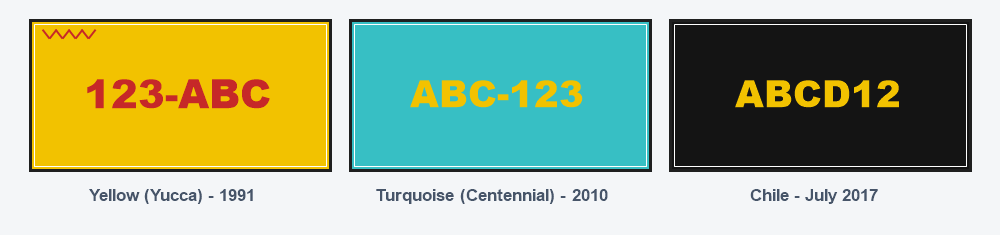
New Mexico license plate format follows a pattern that changes with the design, and the pattern tells a reader which plate they are looking at. The yellow design runs on 123-ABC, the turquoise design on ABC-123 and the chile design on ABCD12. Six letters never appear on a regular passenger plate at all, a rule that reaches back to the 1970s. This page sets out the formats, the excluded letters, the old county codes and the way to read a serial at a glance.
New Mexico license plate numbers carry a history that a modern plate no longer shows. Between 1947 and the 1970s, a number at the front of a serial named the county where the plate was issued, and a county-name sticker followed in a stamped recess at the top center. The state moved to a statewide serial and dropped both practices. A plate issued today carries no county mark whatsoever.
- 3Serial formats in use
- 6Letters never used
- 1972ABC-123 format begins
- 1947County codes begin
- 0County marks on a modern plate
The Serial Format of Each Design
Each of the three standard designs arranges its characters in a way of its own, which makes the format a quick way to confirm which plate you are reading. The pattern follows the design rather than the driver’s preference, so a choice of plate is a choice of serial too.
The yellow design: 123-ABC
The yellow plate runs on three digits followed by three letters, a format the state introduced in the early 1970s when it moved to a statewide serial. The plate designs set the colours and the artwork. The letters I, O, Q, U and V were left out from the start, and the letter E joined the excluded group later. A serial of this shape places the plate in the yellow series, which has stayed in production longer than any other design on the road.
The turquoise design: ABC-123
The turquoise Centennial design reverses the pattern with three letters followed by three digits. The license plate history explains the earlier colours. The design arrived in 2010, and the format gave the state a distinct series for the centennial issue without disturbing the yellow plates already in circulation. A reader who sees letters first knows the plate belongs to the turquoise series rather than to the older one, which makes the two easy to tell apart at a distance.
The chile design: ABCD12
The chile design uses four letters followed by two digits, the longest letter run of the three. The pattern arrived with the design in July 2017 and gave the state a fresh block of serials for the new issue. A reader who sees four letters knows the plate belongs to the chile series. The same format applies to a prestige version, where the characters replace the ordinary serial.
Letters New Mexico Never Uses
The state leaves six letters out of every regular passenger serial, and the rule has held for decades. The excluded set is E, I, O, Q, U and V. The state dropped most of them in 1973, and the letter E stayed out of the 123-ABC format as well. The reason is practical rather than decorative: those shapes are the easiest to confuse with one another and with digits when a person or a camera reads a plate at speed. An I and a 1 look alike, as do an O and a zero, and a V can read as a U. Removing them cuts the number of misreads and makes a plate easier to quote over the phone or record in a system. A personalized request follows the same limit, so a desired word may need a different spelling.
County Codes and Statewide Numbers
New Mexico used county codes for a long stretch of the twentieth century, and the change away from them explains a question drivers ask about old plates. The practice began in 1947 and ran into the 1970s.
How the county code worked
A number at the front of the serial named the county where the plate was issued, in a format such as 1-12345 or 10-1234. The state issues three standard designs at the same time. The code let an officer place a vehicle without a radio check long before a database could answer the question. County-name stickers followed later, pressed into a stamped recess at the top center of the plate so the owner could update the county without a new plate.
The move to a statewide serial
The state moved to a statewide serial and dropped the county coding, which is why a modern plate carries no county mark. The 123-ABC format arrived in the early 1970s and the format has changed only when a new design needed its own series. A driver who sees a number in front of the letters is looking at an older plate rather than a current one, since no design in production today leads with a county code.
Reading a Serial at a Glance
A reader can place a New Mexico plate from the shape of its serial before reading a single character. Four letters and two digits points to the chile design, letters first with three and three points to the turquoise design, and digits first points to the yellow design. The excluded letters then confirm the reading, since a serial containing an I, an O, a Q, a U, a V or an E cannot belong to a regular passenger plate. A personalized serial follows the same rules, so the format holds whether the characters spell a word or not. That makes the pattern a reliable check for a collector dating a plate or a driver confirming a number over the phone.
How a New Mexico Serial Is Built
A serial on a New Mexico plate is not a random string. The the Zia sun symbol sits at the centre of one plate. It follows a small set of rules that decide which characters may appear and in what order, and the rules hold across every design the state issues.
The letters
The letters E, I, O, Q, U and V never appear on a regular passenger plate. The state dropped most of them in 1973 and kept the letter E out of the 123-ABC format as well. The exclusion removes the shapes a person or a camera is most likely to misread. An I and a 1 look alike, as do an O and a zero, and a V can read as a U. A personalized request follows the same limit, which is why a desired word may need a different spelling before it passes review.
The digits
The number of digits follows the design rather than a statewide rule. The yellow plate uses three digits at the front. The turquoise plate uses three at the end. The chile plate uses two at the end after four letters. A serial that carries more digits than its design allows points to a different design or to an older issue. The pattern stays fixed for as long as the design stays in production.
The separator
The Zia sun symbol served as a separator in older formats rather than as a character in the serial. A plate from the 1970s and 1980s may carry the symbol between a group of letters and a group of digits. The modern designs dropped that arrangement in favour of a plain hyphen or no separator at all. A reader who spots the symbol inside a serial is looking at an older arrangement rather than a current one.
What a Plate Number Does Not Tell You
A serial carries a small amount of information, and a reader who expects more from it will be disappointed. Three common assumptions fail against the state’s own rules.
It does not name a county
A number at the front of an old serial named the county where the plate was issued, and that practice ended decades ago. A modern serial belongs to the state as a whole rather than to a county office. Two plates from opposite corners of New Mexico can carry serials that look similar in shape. A reader who wants a county learns nothing from a current plate.
It does not name a year
The state replaced its plates every year for most of the last century, and the year no longer appears on the face. A serial does not encode the year of issue, and the validation sticker carries that detail instead. A collector who wants to date a plate works from the colors, the slogan and the design rather than from the serial. The serial narrows the design, and the design narrows the period.
It does not identify a driver
A plate number points to a registration record, and that record sits behind a federal privacy wall. A stranger who reads a plate cannot convert it into a name or an address through any public service. The plate design and the serial pattern tell a reader the year range rather than the person holding it. That limit protects every driver in the state rather than only the one holding a particular plate.
Plate Numbers and Personalized Text
A personalized plate replaces an ordinary serial with characters of your own, and the same rules decide which characters may appear. Three details govern a request.
The limit follows the design
The turquoise plate allows up to eight characters, the yellow plate seven and the chile plate six. Motorcycle versions allow fewer on each design, with six on yellow and turquoise and five on the chile plate. The gap matters most to a driver who wants a phrase rather than initials. Confirm the limit against the design before counting the characters.
The excluded letters apply
A personalized serial follows the same exclusion as an ordinary one, so the letters E, I, O, Q, U and V never appear. A driver who wants a word containing one of those letters needs a different spelling. The rule exists for readability rather than for style, since a camera misreads those shapes. A request that includes one comes back rather than moving forward.
Symbols are refused
Letters and numbers are the only permitted characters, so a space, dash, underscore, asterisk or hash mark will not pass. A phrase that needs a gap can often drop the gap and read just as well on the plate. The Zia sun symbol cannot appear as part of a serial, since the state reserves it for the design. A driver who wants a symbol should reconsider the wording.
Frequently Asked Questions
These are the questions drivers ask most often about New Mexico plate numbers. Each answer stays short and points to the official source where the state publishes the current rule. Where a detail matters to a collector or a sale, confirm it against a reference rather than a memory.
What format do New Mexico license plates use?
Each design has its own pattern. The yellow plate runs on 123-ABC, the turquoise plate on ABC-123 and the chile plate on ABCD12. A personalized version uses the same format, with your characters in place of the ordinary serial.
Which letters are never used on New Mexico plates?
The letters E, I, O, Q, U and V never appear on a regular passenger plate. The state dropped most of them in 1973 and kept the letter E out of the 123-ABC format as well. The shapes are easy to confuse with digits when read at speed.
What do the numbers at the front of an old plate mean?
Between 1947 and the 1970s, a number at the front of the serial named the county where the plate was issued. The state moved to a statewide serial and dropped the coding, so no plate issued today carries a county mark.
How can I tell which New Mexico design a plate belongs to?
Look at the shape of the serial. Four letters and two digits belongs to the chile design, three letters then three digits to the turquoise design, and three digits then three letters to the yellow design. The excluded letters confirm the reading.
Does a personalized plate follow the same format?
Yes. A personalized serial uses the pattern of the design you choose, with your own characters in place of the ordinary serial. Letters and numbers are the only permitted characters, and a space, dash or symbol will not pass review.