New Mexico License Plate History: 1912 to Today
New Mexico license plate history begins on 8 June 1912, months after the territory became a state, and the first plates arrived before a single highway carried cars between towns. The state has changed color, format and artwork many times since then. A Zia sun symbol appeared in 1927, a slogan arrived in 1941 and a county code sat at the front of the serial for three decades. This page walks through the changes in order and explains what a driver can read from an older plate.
New Mexico license plate history explains details on the plates issued today. The letters E, I, O, Q, U and V never appear on a modern serial, a rule that reaches back to 1973 for most of them. The state moved from county codes to a statewide serial, and the yellow design has stayed in production since 1991. Reading the older changes makes the current designs easier to place in time.
- 1912First plates issued
- 1927Zia symbol appears
- 1941Land of Enchantment debut
- 1972ABC-123 format begins
- 1991Yellow design enters service
The First New Mexico Plates
The state began issuing plates in the same year it joined the union, which put New Mexico among the earliest group of states with a formal system. Those early plates carried little more than a number and the state name, and the format changed almost every year as registrations grew.
1912: the first issue
New Mexico issued its first plates on 8 June 1912, six months after statehood. The early issues were produced in small runs and replaced each year, which is why a surviving 1912 plate is a rare item rather than a common one. The state name and a serial carried the whole design, since artwork and slogans did not appear until later decades.
What the early years changed
The first three decades brought new colors, new sizes and a changing serial length as the number of vehicles grew. The the Zia sun symbol sits at the centre of one plate. A plate from the 1920s looks quite different from a plate from the 1930s, and the changes followed the state’s own growth rather than a national standard. Collectors use the color and the slogan to date an early plate when the year itself does not appear on the face.
The Zia Symbol Arrives in 1927
The 1927 issue changed the look of a New Mexico plate in two ways that lasted. The state spelled its name in full for the first time, and it placed the Zia sun symbol on the plate with the two-digit year inside the symbol itself. That arrangement gave the state a visual identifier it still uses today, and it makes a 1927 plate easy to recognise. The symbol comes from Zia Pueblo and carries four rays on each of four sides, a set of numbers tied to the pueblo’s own reckoning of the world. New Mexico has kept the element on its plates ever since, and it now sits at the center of the turquoise design.
Slogans Through the Years
The words on a New Mexico plate have changed less often than the colors, and two slogans cover most of the history. Each one tells a reader something about the year the plate was issued.
Sunshine State, 1932
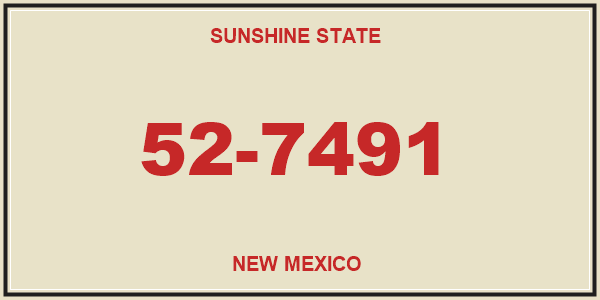
The 1932 issue carried the words SUNSHINE STATE along the bottom, a line the state later set aside. A plate with that wording dates to a single year, which makes it one of the easier early issues to place. The phrase has no connection to the modern designs, so a driver who sees it on a vintage plate is looking at a short-lived choice rather than a long-running slogan.
Land of Enchantment, 1941
The state first used THE LAND OF ENCHANTMENT on a plate in 1941, and the wording has stayed on New Mexico plates in one form or another since then. Each design runs on a plate serial format of its own. The state adopted the phrase as its motto for official use, and it now appears on all three designs in production. A collector reading the line on an old plate can place it in the period after 1941.
The War Years and the Years After
The Second World War reached the state’s plates in a practical way. New Mexico revalidated the 1942 plate for 1943 with a windshield sticker rather than issuing new metal. Steel went to the war effort. The same pressure produced similar steps in other states, and it left a gap in the yearly series that collectors watch for. The 1940 issue in front of that period marked the four hundredth anniversary of the Coronado expedition, which makes it a commemorative design rather than an ordinary one. The years after the war brought a return to yearly metal plates and a fresh set of colors.
County Codes and Statewide Serials
The state used county codes for a long stretch of the twentieth century, and modern plates carry none of them. The change is worth knowing, since it settles a question drivers ask about a number at the front of an old serial.
1947 to the 1970s
Between 1947 and the 1970s, a number at the front of the serial named the county where the plate was issued. The license plate collectors hold runs the state no longer makes. A serial reading 1-12345 came from one county and 10-1234 from another, which let an officer place a vehicle without a radio check. County-name stickers followed later, pressed into a stamped recess at the top center of the plate, and the state discontinued that practice as well.
The move to a statewide serial
New Mexico moved to a statewide serial and dropped the county coding, which is why a plate issued today carries no county mark. The 123-ABC format arrived in the early 1970s, and the state left the letters I, O, Q, U and V out of it from the start. The letter E joined the excluded group later. A modern serial belongs to the state as a whole rather than to a county office.
The Three Modern Designs
Three designs share the road today, and each one dates to a different decade. Together they cover more than thirty years of the state’s plate history.
The yellow design, 1991
The yellow plate entered service in 1991 with red characters, a light blue yucca at the lower left and Native zigzag bands at the top corners. It replaced the earlier issues in a single change and has stayed in production since, which makes it the longest-serving design on the road. A stamped recess at the top center once held a county-name sticker, a feature the state later dropped.
The turquoise and chile designs
The turquoise Centennial design arrived in 2010 to mark the state’s hundredth year, and the Automobile License Plate Collectors Association named it the best new plate of that year. The chile design followed in July 2017 with a black field and two chile peppers, and the same association named it the best new plate of 2017. Both awards make New Mexico one of the few states honoured twice by the group.
Reading an Old New Mexico Plate
An old plate carries three clues, and a reader who knows them can place it in time without a reference book. Each clue sits in a fixed position on the face, which makes the reading quick once the habit forms.
The colors and what they date
New Mexico changed colors often in its early decades, and a color pair narrows the year rather than naming it. Red on yellow, black on yellow and white on blue all appear in the first forty years, and each combination belongs to a short run. A collector who knows the pairs can place a plate within a few years from the colors alone. The modern designs then sit apart, since each one holds a palette of its own.
The slogan and the year
The slogan is the strongest clue of the three. The 1932 issue carried SUNSHINE STATE, and the phrase disappeared within a few years. The words LAND OF ENCHANTMENT appear from 1941 onward, which sets a clear boundary. The 1940 plate marks the Coronado anniversary instead, so it carries wording tied to a single event. A reader who checks the slogan first saves time on everything else.
The serial and the county
Between 1947 and the 1970s, a number at the front of the serial named the county where the plate was issued, in a format such as 1-12345 or 10-1234. A plate with that shape comes from the middle of the century rather than from the modern period. The state moved to a statewide serial and dropped the coding, which is why a plate issued today carries no county mark. A collector who reads the code learns a place rather than a year.
New Mexico Plates by Decade
The state replaced its plates every year for most of the last century, which gives each decade a character of its own. A collector can group a collection by period rather than by color.
1912 to 1929
The first plates arrived on 8 June 1912, six months after statehood, and the early issues were produced in small runs. The Zia sun symbol reached the plates in 1927, in the same year the state began spelling its name in full. The two-digit year once sat inside the symbol itself, which makes a late-1920s plate easy to spot. Surviving plates from this period are rare rather than common.
1930 to 1949
The 1930s brought the Sunshine State line and the Coronado anniversary issue of 1940. The Second World War reached the plates in a practical way, when New Mexico revalidated the 1942 plate for 1943 with a windshield sticker rather than issuing new metal. Steel went to the war effort, and other states took similar steps. The gap in the yearly series that followed is a detail collectors watch for.
1950 to 1991
The post-war decades brought a return to yearly metal plates and a fresh set of colors. County codes ran through the middle of the period and the statewide 123-ABC format arrived in the early 1970s. The yellow yucca design entered service in 1991 and has stayed there since, which makes it the longest-serving design on the road. A collector who wants a complete run focuses on this stretch, since the plates are easier to find.
What Survives and What Does Not
Not every plate from the past is still available, and the reasons differ by period. A collector who knows which runs are thin saves money on the ones that are not.
The earliest plates are rare
The first issues were produced in small runs and replaced every year, which means a pre-war plate survived only when someone kept it. A 1912 plate is a rare item rather than a common one. The state had few vehicles in those years, so even a complete run would hold fewer plates than a single year in the 1970s. A collector who wants an early plate should expect to pay for the scarcity.
The war years left a gap
New Mexico revalidated the 1942 plate for 1943 with a windshield sticker rather than issuing new metal, since steel went to the war effort. That step left a gap in the yearly series, and the plates on either side of it sit closer together in a collection than the calendar suggests. Other states took similar steps for the same reason. A collector who wants a complete run watches for that break.
The modern designs are everywhere
The three standard designs have run for decades, which makes them easy to find and cheap to buy. A yellow plate from the 1990s turns up at any swap meet, and a turquoise or chile plate from the last decade is still on the road. A collector who wants a modern set completes it quickly. The value in those designs sits in a low serial rather than in the design itself.
Frequently Asked Questions
These are the questions drivers ask most often about the history of New Mexico plates. Each answer stays short and points to the official source where the state publishes the current design. Where a detail matters to a collector or a sale, confirm it against a reference rather than a memory.
When did New Mexico first issue license plates?
The state issued its first plates on 8 June 1912, six months after joining the union. The early issues were produced in small runs and replaced each year, which makes a surviving first-year plate a rare item rather than a common one.
When did the Zia symbol first appear on a plate?
The Zia sun symbol reached New Mexico plates in 1927, in the same year the state began spelling its name in full. The two-digit year once sat inside the symbol itself. The element has stayed on the state’s plates ever since.
What did the 1932 New Mexico plate say?
The 1932 issue carried the words SUNSHINE STATE along the bottom rather than Land of Enchantment. The state later set the line aside, which makes a 1932 plate easy to date from the wording alone.
Why did New Mexico plates carry county numbers?
Between 1947 and the 1970s, a number at the front of the serial named the county where the plate was issued. The state later moved to a statewide serial and dropped the coding, which is why a modern plate carries no county mark.
What are the three current New Mexico plate designs?
The yellow design arrived in 1991, the turquoise Centennial design in 2010 and the chile design in July 2017. None of them has replaced the others, so all three stay in production together. The state has taken two national best-plate awards across those designs.