New Mexico License Plate Designs and Colors
New Mexico license plate designs come in three standard looks, and color is the quickest way to tell them apart at a distance. One carries red characters on a yellow field, one carries yellow characters on turquoise, and one carries yellow characters on black. All three stay in production at the same time, so the state has no single current plate. This page covers each color scheme, the serial pattern behind it, the materials the state uses, the plates that will not register a vehicle and the way the catalogue has grown.
New Mexico license plate designs decide how many characters a personalized plate may hold. The turquoise design allows eight, the yellow design seven, and the chile design six. Each one runs on a serial pattern of its own, and the letters E, I, O, Q, U and V never appear on a regular passenger plate. Two of the three designs have taken a national award for best new plate, in 2010 and again in 2017, which makes the state one of the few honored twice by the collectors’ association.
- 3Standard designs in production
- 1991Yellow plate introduced
- 2010Turquoise plate introduced
- 2017Chile plate introduced
- 2National best-plate awards
What Color Are New Mexico License Plates?
New Mexico issues three colors rather than one, and a driver picks a single design at registration. The full range sits on the New Mexico license plates hub. Each color carries its own artwork, its own serial pattern and its own place in the state’s history. The table further down sets the three side by side, and the sections here cover what sits where on the face of each plate.
Red characters on a yellow field
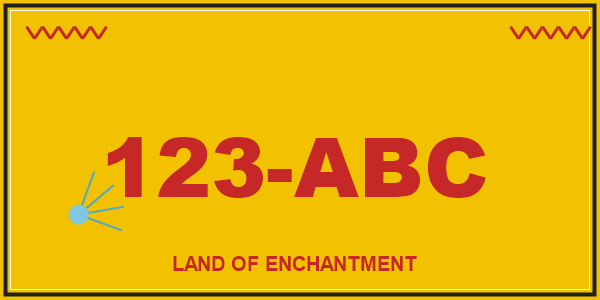
The classic New Mexico plate pairs red characters with a yellow background, a color scheme drawn from the state flag. The yucca, the state flower, runs along the lower left in light blue, and Native zigzag bands mark the top corners. The design entered production in 1991 and has stayed there since, which makes it the longest-serving of the three. A county-name sticker once sat in a stamped recess at the top center, a practice the state ended years ago.
Yellow characters on a turquoise field
The turquoise plate reverses the pairing, with yellow characters on a field of turquoise and the Zia sun symbol embossed in yellow and red at the center. The the Zia sun symbol sits at the centre of one plate. New Mexico released it in 2010 to mark its centennial, so the top line reads CENTENNIAL 1912-2012 and the bottom reads LAND OF ENCHANTMENT. The Automobile License Plate Collectors Association named it the best new plate of that year, the first such award the state had taken. A revised version later dropped the anniversary wording and kept the field and the centered symbol.

Yellow characters on a black field
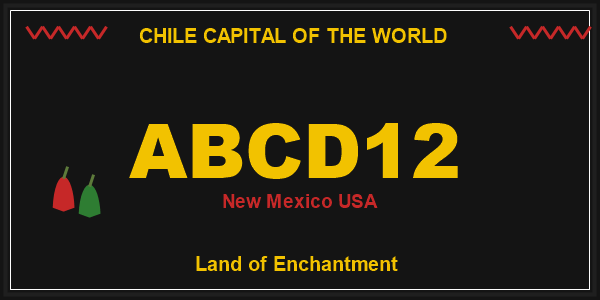
The chile plate sets yellow characters on black, with a red chile and a green chile screened at the left. The top line reads CHILE CAPITAL OF THE WORLD and the bottom carries Land of Enchantment. New Mexico released the design on 10 July 2017, moving early in a long-running contest with Colorado over that claim. The same association named it the best new plate of 2017, the state’s second win. The words New Mexico USA sit in red below the serial, which answers a practical question for an officer reading the plate in another state.
Telling them apart at a glance
Color settles most questions, and the remaining details confirm the answer. A yellow field with red text is the classic design. A turquoise field with yellow text carries the centennial line at the top on the earlier run. A black field with yellow text carries two chile peppers at the left and the words New Mexico USA below the serial. The serial pattern then confirms it, since each design arranges its letters and numbers in a way of its own. A reader who checks the two details together will not mistake one design for another.
| Color scheme | Introduced | Serial format | Slogan line |
|---|---|---|---|
| Yellow field, red characters | 1991 | 123-ABC | Land of Enchantment |
| Turquoise field, yellow characters | 2010 | ABC-123 | Centennial 1912-2012 |
| Black field, yellow characters | July 2017 | ABCD12 | Chile Capital of the World |
How Many Designs New Mexico Offers
Three standard designs sit alongside a broad catalogue of specialty options, and the two groups follow different rules. The standard colors cover passenger cars, trucks and, in shorter sizes, motorcycles, and a driver chooses one at registration at no added charge. Everything beyond those three carries a fee of its own.
Standard designs and specialty designs differ
A standard design comes with the registration and costs nothing extra. Each design runs on a plate serial format of its own. A specialty design adds a yearly charge that often funds a cause. Plates for the University of New Mexico, the New Mexico State University and other campuses sit in the specialty group. So do the veteran, wildlife, organ donor and Route 66 designs. Government, agency and commercial plates stay outside the public process altogether, since only the state issues those to its own vehicles and staff.
What each standard design allows
The design you hold sets the length of any personalized text. The turquoise plate takes up to eight characters, the yellow plate seven, and the chile plate six. Motorcycle versions allow fewer on each color. Letters and numbers are the only permitted characters, and a space, dash or symbol will not pass review. A driver planning a longer phrase should check the limit against the design before the application goes in.
How the catalogue has grown
New Mexico issued a single design at a time for most of the last century, and the choice arrived only when a new design replaced an old one. The state changed that approach in the 1990s, when the yellow plate joined the road alongside earlier issues rather than replacing them outright. The specialty catalogue grew at the same time, as institutions and causes won their own plates through the legislature. A driver today picks from three standard designs and a long list of specialty options rather than waiting for the state to change its mind.
The Serial Pattern Behind Each Design
Each design arranges its characters in a way of its own, which makes the serial a quick way to confirm which plate you are reading. The license plate gallery shows every design in one place. The pattern follows the design rather than the driver’s preference.
123-ABC, ABC-123 and ABCD12
The yellow design runs on three digits followed by three letters. The turquoise design reverses the order with three letters first. The chile design uses four letters followed by two digits, the longest letter run of the three. A reader who sees letters before digits knows the plate belongs to the turquoise series, and four letters points to the chile design. The state moved to the 123-ABC pattern in the early 1970s, when it dropped the county coding that had come before.
The letters New Mexico leaves out
The letters E, I, O, Q, U and V never appear on a regular passenger plate. The state dropped most of them in 1973 and kept the letter E out of the 123-ABC format as well. A camera and an officer both misread those shapes, so leaving them out removes an easy source of error. An I and a 1 look alike, as do an O and a zero, and a V can read as a U. A personalized request follows the same limit, so a desired word may need a different spelling before it passes review.
Materials, Size and Maker
The physical plate changes very little between colors, since one plant produces all of them to a single specification. That consistency makes a New Mexico plate easy to recognize from the back of the plate and from the front.
Aluminum stock and standard dimensions
New Mexico plates start as aluminum sheet and finish at the 12 by 6 inch size used across North America. The characters are embossed rather than printed flat, which gives the plate a raised profile. Reflective sheeting sits behind the characters so the plate stays readable at night, and a screen print adds the artwork and the slogan. A plate that has lost that sheeting reads as dull grey rather than white, which is one reason a worn plate needs replacing.
Where the plates are produced
Waldale Manufacturing Limited of Amherst, Nova Scotia produces New Mexico plates. Every design, from the yellow plate to the newest chile issue, comes out of the same plant to the same size and material specification. The state orders a run of a design, and each plate then carries its own serial within that run. A driver who compares two plates issued years apart will find the same stock thickness and the same embossing depth.
How the artwork reaches the metal
The characters are pressed into the aluminum before anything else, which is why a New Mexico serial has depth rather than a flat finish. The screen print then lays the artwork and the slogan across the face of the plate. On the yellow design the yucca and the zigzag bands arrive in that print, and on the turquoise design so does the top line. Reading the surface on a close look shows the print sitting slightly above the metal, which is the mark of a genuine plate rather than a reproduction.
Decorative, Novelty and Sample Plates
Not every plate sold with a New Mexico design will register a vehicle, and the difference matters at a stop. A decorative plate bought from a shop, a website or a souvenir stand has no registration record attached to it.
Sample and fun plates
New Mexico sells sample and “Fun” plates for $9.99 each, and every one carries the words NOT FOR REGISTRATION. The wording makes the plate a display item rather than equipment for a car, so it suits a wall, a desk or a gift. The state offers them so a driver can own the design without putting it on the road. Collectors keep them alongside older issues rather than on a bumper.
Novelty plates from other sellers
A novelty plate from a souvenir shop or a website carries a design of its own and no state record. Fitting one to a registered vehicle invites a citation, since a plate that does not match the registration fails the basic test. Collectors buy these plates for display and for restoration projects rather than for road use. A driver who wants the genuine look should order from the state rather than from a marketplace listing.
Historic Designs You May Still See
Older New Mexico plates turn up on the road, at swap meets and in garages, and a few of them explain details on the modern designs. A reader who knows the markers can date a plate without a reference book.
County-coded serials
Between 1947 and the 1970s, a number at the front of the serial named the county where the plate was issued. A driver reading a modern plate will find no such code, since the state moved to a statewide serial long ago. A collector who reads a two-digit code at the front of an old plate is looking at a place rather than a year. The old county coding has no bearing on a plate issued today.
Designs no longer produced
Some designs have come and gone, including a balloon plate that the state no longer makes. Year-of-manufacture plates let an owner of a vehicle 30 years and older run a period-correct plate under a set of conditions of its own. Confirm the current status of any design on the MVD catalogue before you rely on it. A collector who wants a retired design usually finds one through a private seller rather than through MVD.
Commemorative issues
New Mexico has used a plate to mark an anniversary more than once. The 1940 issue carried a Coronado reference for the four hundredth anniversary of the expedition, and the turquoise design marked the state’s centennial in 1912-2012. Commemorative plates date to a short run rather than to a long one, which keeps them scarce. A collector watches for the wording at the top, since that line names the occasion rather than the design.
Choosing Between the Three
A driver picks one design at registration, and the choice rests on taste rather than price. Two practical details decide the matter for most people, and both are worth checking before the counter.
What the choice costs
All three designs issue at the same price, so a standard registration covers the plate whichever one you choose. A specialty design adds a yearly charge, and a personalized plate adds a figure of its own for the characters. A driver comparing the three standard colors should expect the same bill from each. The cost only changes when the design leaves the standard group.
What the colors signal
The yellow plate reads as the classic New Mexico design and has held that position for more than three decades. The turquoise plate ties to the state’s centennial and carries the most room for personal text. The chile plate offers the highest contrast of the three and takes the fewest characters. A driver who wants a long phrase looks at the turquoise plate. A driver who wants the sharpest look at distance looks at the chile design.
Frequently Asked Questions
These are the questions drivers ask most often about New Mexico plate designs. Each answer stays short and points to the official source where the state publishes the current catalogue. Where a detail affects money or a deadline, confirm it with MVD before you rely on it.
What color are New Mexico license plates?
New Mexico issues three colors at once: yellow with red characters, turquoise with yellow characters, and black with yellow characters. A driver picks one design at registration, and the choice costs nothing beyond the standard registration fee.
How many standard license plate designs does New Mexico have?
Three. The yellow design arrived in 1991, the turquoise design in 2010 and the chile design in July 2017. None of them has replaced the others, so all three stay in production together alongside a long specialty catalogue.
Where are New Mexico license plates made?
Waldale Manufacturing Limited of Amherst, Nova Scotia produces them from aluminum stock. The finished plate matches the 12 by 6 inch size used across North America, with embossed characters and reflective sheeting behind them.
What serial format does each design use?
The yellow plate runs on 123-ABC, the turquoise plate on ABC-123, and the chile plate on ABCD12. The letters E, I, O, Q, U and V never appear on a regular passenger plate, a rule that reaches back to 1973 for most of them.
Can I put a decorative plate on my car?
No. A decorative or novelty plate carries no registration record, and fitting one to a registered vehicle invites a citation. New Mexico sells sample plates marked NOT FOR REGISTRATION for display, and collectors keep novelty plates for the wall rather than the bumper.