New Mexico Plate Symbols and Their Meaning
New Mexico license plate meaning comes down to a small set of symbols and a short list of phrases, and each one traces back to the state’s own history. The Zia sun symbol sits at the center of one design, the yucca runs along another, and two chile peppers mark the third. The words carry just as much weight, since Land of Enchantment has appeared on New Mexico plates since 1941. This page explains what each element stands for, where it came from, which line replaced an earlier one, and how the colors tie back to the state flag.
New Mexico license plate symbols carry a serial pattern that reads as a code once you know the rules. The letters E, I, O, Q, U and V never appear on a regular passenger plate, and each design arranges its characters in a way of its own. The symbols belong to the state and to the pueblo that shares them, which makes a little background worth having before you read a plate on the road. A reader who knows the elements can date a plate from across a car park.
- 1927Zia symbol first on a plate
- 1941Land of Enchantment debut
- 1932Sunshine State plate
- 6Letters never used
- 3Designs in production
What the Symbols on a New Mexico Plate Mean
Three visual elements carry the weight of the design, and two of them reach back further than the plates themselves. The full range sits on the New Mexico license plates hub. A reader who knows the three can date a plate and place it on an older vehicle from across a parking lot. Each one sits in a fixed position, so a glance at the layout tells you which design you are looking at.
The Zia sun symbol
The Zia sun symbol comes from Zia Pueblo, and it carries four rays on each of four sides, a set of numbers tied to the pueblo’s own reckoning of the world. The symbol belongs to Zia Pueblo and holds deep significance for its members. New Mexico placed it on its plates in 1927, and the two-digit year once sat inside the symbol itself. It now stands as the central element of the turquoise design, embossed in yellow and red so that it rises above the field of the plate.
The yucca and the zigzag bands
The yucca is New Mexico’s state flower, and its light blue form has run along the lower left of the yellow plate since the early 1990s. The license plate history explains the earlier colours. Native zigzag bands mark the top corners of the same design, a nod to the Pueblo and Navajo traditions of the region. Together the two elements gave the 1991 issue a look that drivers still call the classic New Mexico plate, and the design has stayed in production for more than three decades. The bands sit above the serial rather than beside it, which keeps the characters clear at a distance.
The chile peppers
A red chile and a green chile sit at the left of the black design, screened rather than embossed. The pairing answers a question the state treats as serious, since New Mexico calls itself the Chile Capital of the World. The two colors nod to the state’s signature question at a restaurant counter, where a server asks whether the diner wants red or green. The peppers occupy the space the yucca holds on the yellow plate, which gives the two designs a similar layout with different artwork.
What the symbols do not mean
The elements on a New Mexico plate carry no personal information about the driver, and none of them names a county, a city or a year on a modern issue. A serial that begins with a number does not point to a place, since the state dropped county coding decades ago. The colors belong to the state rather than to the vehicle, so two cars registered in the same month may carry two different designs. A reader looking for a hidden message will not find one, and the plate stays a state document with state artwork on it.
The Words on a New Mexico Plate
The phrases change less often than the artwork, and each one carries a story. Four of them appear across the three designs in production today, and a fifth sits on one design alone.
Land of Enchantment
The state has used the words Land of Enchantment on its plates since 1941, and the phrase now sits on all three current designs. Each design runs on a plate serial format of its own. The turquoise plate adds CENTENNIAL 1912-2012 above it, and the chile plate adds CHILE CAPITAL OF THE WORLD. The yellow plate carries the slogan on its own at the bottom of the field, which makes it the simplest of the three to read at a distance. The wording survived every redesign that followed, which tells you how firmly the state holds to it.
Sunshine State: the earlier line
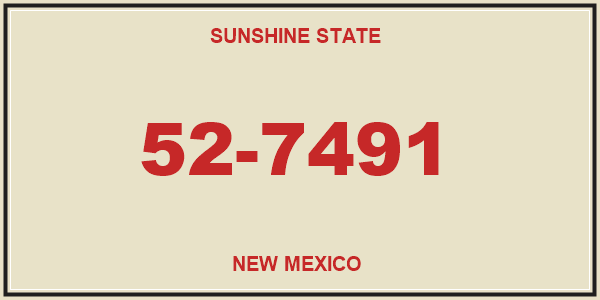
One earlier plate broke the pattern. The 1932 issue carried the words SUNSHINE STATE instead, a line the state later set aside in favour of the phrase drivers know today. The change makes the 1932 plate a recognised item among collectors, and it explains why a vintage New Mexico plate may carry wording that looks out of place. A plate with that line dates to a single year, so a collector uses it as a marker rather than as a variant of the modern slogan.
Chile Capital of the World
The chile design carries its own headline in yellow across the top, and the line stakes a claim New Mexico has defended for years. The state released the plate on 10 July 2017, moving early in a long-running contest with Colorado over the title. The Automobile License Plate Collectors Association named the design the best new plate of that year, the state’s second win after the turquoise plate took the honour in 2010. The headline sits in yellow so that it reads against the black field without competing with the serial.
New Mexico USA
The words New Mexico USA sit below the serial on the chile design, and they answer a practical problem. The state issues three standard designs at the same time. New Mexico shares a border with the country of Mexico, so a plate that reads Chihuahua or Sonora can look similar to a state plate at a glance. The state added USA to its plates in the late 1960s to settle the question, and the chile design keeps the wording in red below the characters. An officer reading the plate in another state sees the country named before anything else.
Centennial 1912-2012
The turquoise design carries CENTENNIAL 1912-2012 across the top, a line that ties the plate to a single anniversary rather than to an ordinary year. New Mexico became a state in 1912, so the hundredth year fell in 2012 and the state released the plate two years early. A revised version later dropped the anniversary wording and kept the turquoise field and the centered symbol, which means a plate in service today may carry either version. A reader who sees the centennial line knows the plate came from the earlier run.
What the State Motto Adds
New Mexico carries Land of Enchantment as its motto and as its plate slogan, which gives the phrase a longer life than a design choice. The state adopted the wording for official use before the plates carried it, and the phrase now appears on road signs, tourism material and licenses along with the plates. A driver who reads the line on a plate is reading the state’s own summary of itself, which is why the wording has survived every redesign since 1941. The phrase has outlasted six decades of changes to the artwork around it, and no design has replaced it with a different line. That continuity makes the slogan the single most reliable way to date a New Mexico plate.
Why the Zia Symbol Carries Weight Beyond the Plate
The symbol is not the state’s own invention, and that distinction matters to the people it belongs to. A reader who understands where it comes from uses it with more care than a decorative mark would require.
The pueblo behind the symbol
Zia Pueblo holds the symbol as part of its own cultural inheritance, and the design carries meaning that reaches well past a registration plate. The four rays on each of four sides map to a set of numbers the pueblo uses in its own view of the world. New Mexico placed the element on its plates in 1927, and the state has kept it there through every redesign since. The symbol appears on the state flag as well, which makes it one of the most visible marks New Mexico uses.
Using the symbol with care
A driver who carries the symbol on a plate carries a piece of someone else’s heritage, and that calls for a little respect rather than a joke. A personalized request cannot use the Zia symbol as part of its text, and the state rejects a special character of any kind for that reason. Treating the element as decoration rather than as a cultural mark misses the point of why it sits at the center of the turquoise design. A reader who knows the background reads the plate differently from one who does not.
Reading the Serial Pattern
The letters and numbers follow rules that make a plate easier to read and harder to forge. Knowing them turns a serial into a small amount of information about the plate itself, which helps a reader place a plate and helps a collector date one.
The letters New Mexico leaves out
The letters E, I, O, Q, U and V never appear on a regular passenger plate. The state dropped most of them in 1973 and kept the letter E out of the 123-ABC format as well. A camera and an officer both misread those shapes, so leaving them out removes an easy source of error. An I and a 1 look alike, as do an O and a zero, and a V can read as a U. A personalized request follows the same limit, so a desired word may need a different spelling before it passes review.
A serial pattern for each design
The yellow design runs on 123-ABC, the turquoise design on ABC-123 and the chile design on ABCD12. The Zia symbol itself serves as a separator in older formats rather than as a character in the serial. County numbers sat at the front of a serial between 1947 and the 1970s, and modern plates carry no county code at all. A reader who sees letters before digits knows the plate belongs to the turquoise series, and four letters points to the chile design.
County codes on older plates
A number at the front of an old serial named the county where the plate was issued, in a format such as 1-12345 or 10-1234. The code let an officer place a vehicle without a radio check long before a database could answer the question. County-name stickers followed later, pressed into a stamped recess at the top center of the plate. The state moved to a statewide serial and dropped both practices, which is why a plate issued today carries no county mark whatsoever.
The Colors and What They Signal
Each design builds its palette from the state’s own symbols rather than from a national standard. The result gives New Mexico three plates that look nothing alike, which makes the designs easy to tell apart on the road.
Red and yellow: the state flag
The yellow design draws its colors from the state flag, which pairs a yellow field with a red Zia sun symbol at the center. The plate reverses the arrangement by placing red characters on a yellow field, and the pairing has survived every redesign since the early 1990s. The colors read sharply against each other, which gives the yellow plate the highest contrast of the three. A camera and an officer both find that contrast useful at a distance.
Turquoise and the centennial
The turquoise design chose a color no earlier New Mexico plate had come close to, and the choice drew comment when the state released it in 2010. Collectors noted at the time that yellow characters on a turquoise field read less sharply than red on yellow, since the two colors sit closer together in tone. The embossed characters and the reflective sheeting behind them offset most of that. The color ties the plate to the state’s own association with turquoise, which makes it a deliberate choice rather than a fashion.
Black and the chile plate
The chile design uses a black field with yellow characters, which gives it more contrast than the turquoise plate and a different feel from the yellow one. The two chile peppers supply the only other colors on the face, and they sit to the left rather than across the middle. The black background makes the artwork stand out in a photograph, which helped the design when it took a national award in its first year. A driver who wants the strongest contrast on the road has two options rather than one.
Slogans That Did Not Last
New Mexico has tried a small number of other lines over the years, and each one left a marker that a collector watches for. The 1932 issue carried SUNSHINE STATE rather than the phrase drivers know today, and the state set the line aside within a few years. The 1940 plate marked the four hundredth anniversary of the Coronado expedition rather than an ordinary year, which makes it a commemorative issue. Neither line returned, and the state settled on Land of Enchantment for the long run. A reader who sees an unfamiliar slogan on a New Mexico plate is looking at an older issue rather than at a variant of the modern designs.
Frequently Asked Questions
These are the questions drivers ask most often about the symbols and words on a New Mexico plate. Each answer stays short and points to the official source where the state publishes the current design. Where a detail matters to a collector or a sale, confirm it against a reference rather than a memory.
What does the Zia symbol on a New Mexico plate mean?
The Zia sun symbol comes from Zia Pueblo and carries four rays on each of four sides, a set of numbers tied to the pueblo’s own reckoning of the world. New Mexico placed it on its plates in 1927, and it now sits at the center of the turquoise design.
What does Land of Enchantment mean on a plate?
It is the state’s own summary of itself, used on New Mexico plates since 1941 and adopted as the motto alongside the slogan. The phrase now appears on all three designs in production, and on official material well beyond the plates.
Why did an older New Mexico plate say Sunshine State?
The 1932 issue carried the words SUNSHINE STATE instead of Land of Enchantment. The state later set the line aside in favour of the phrase drivers know today, which makes the 1932 plate a recognised item among collectors.
Why do New Mexico plates say USA?
The words New Mexico USA sit below the serial on the chile design. New Mexico shares a border with the country of Mexico, so a plate carrying a Mexican state name can look similar at a glance. The state added the wording in the late 1960s to settle the question.
Which letters never appear on a New Mexico plate?
The letters E, I, O, Q, U and V never appear on a regular passenger plate. The state dropped most of them in 1973 and kept the letter E out of the 123-ABC format as well. A camera and an officer both misread those shapes.